Showing posts with label butternut. Show all posts

Wednesday, October 3, 2012

Grapes!

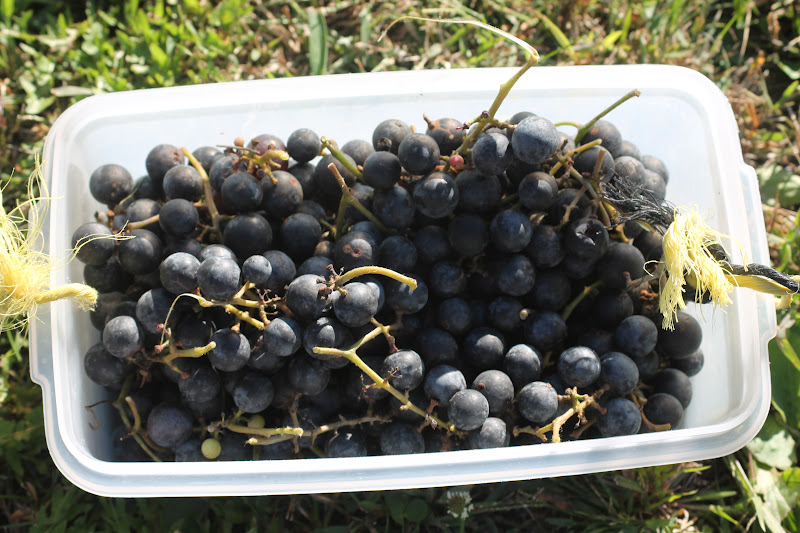
Concord grapes.
I'd been watching the grapes get ripe, but I assumed I wouldn't get any. That was mostly because a friend used to have a tree that was covered in grape vines, and she told me that every year the grapes hung in tantalizing bunches and that every year the squirrels and chipmunks got all the grapes before the people got a single one. Still, I'd been watching, hoping.

Then, a couple of weeks ago, I went out to pick autumnberries after the kids went to bed. On the way, I took a spontaneous detour at a trail we frequent (it's the one with our "picnic rock," a boulder perfect for sitting atop with a picnic lunch). I thought I'd see how the grapes were doing.

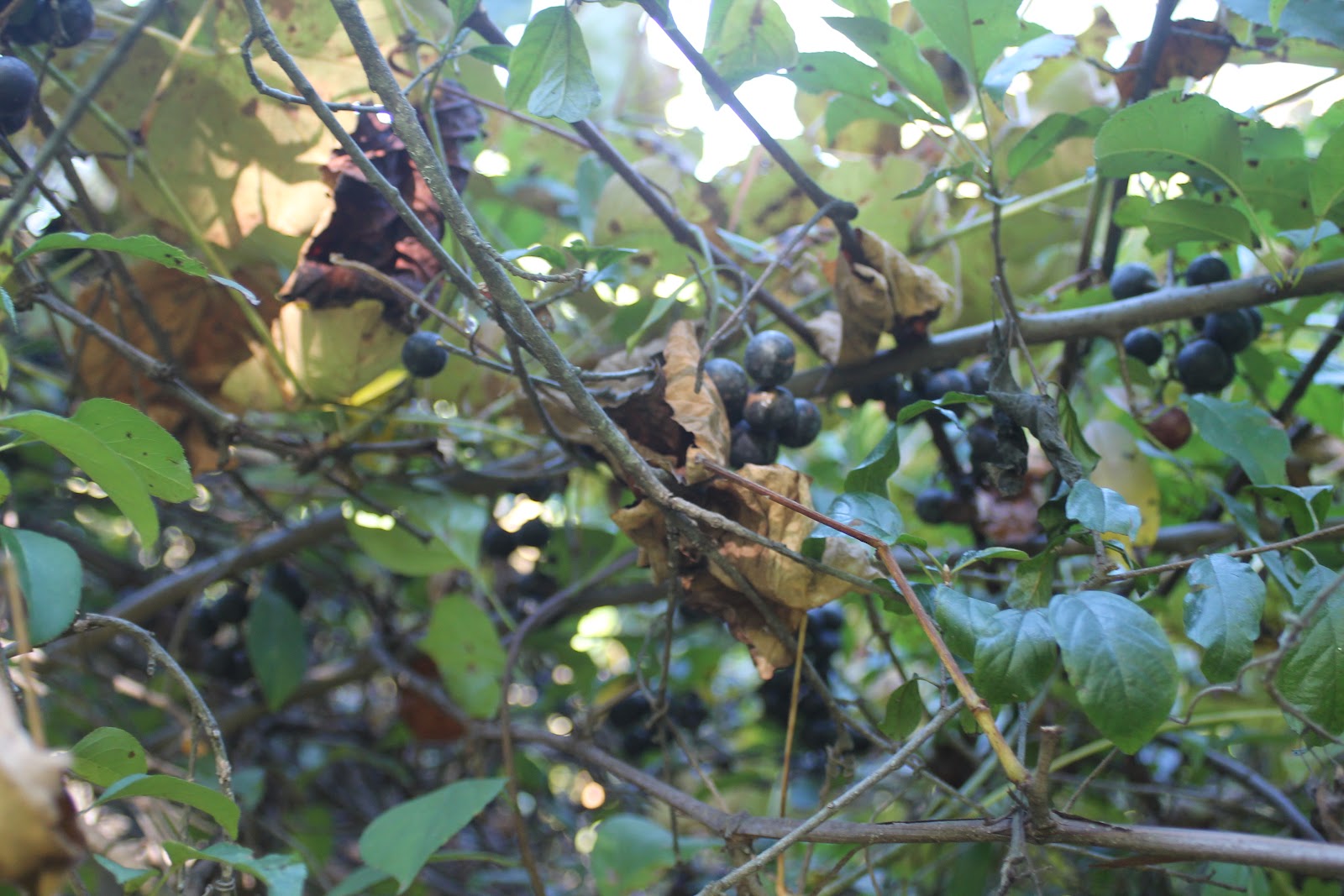
I had to reach through a tangle of vines
and branches to pick these grapes.
I could smell them before I could see them. Then there they were, hanging underneath a mess of invasive vines and prickers. They weren't the easiest fruits to pick -- I had to gingerly reach into the spaces between the vines to pluck each cluster. Many grapes hung far in the back where I couldn't reach. I picked what I could and went a little farther down the trail.

The grapes at the top of this tree
were far out of reach.
Soon the strong, musky smell of grapes filled the air again. I looked to my left and saw a tall mass of vines -- there must have been a tree underneath there somewhere -- and beautiful purple grapes hanging far at the top. Oh, how I wanted to be able to fly! Alas, I had to make do with the fruits hanging at trail level. I picked until my small bucket -- chosen to accommodate the much tinier autumnberries rather than grapes -- was full. Reluctantly, I left the rest of the fruit dangling, unpicked, until I could come back.

My husband pulls
a grape-laden
branch within reach.
A couple of nights later, I was back on the trail with the my family in tow. This time we brought the hook my husband made for me last year. It's a carved walking stick with a hook at the top, and it's ideal for pulling high, fruit-laden branches into reach. Although wings (or a ladder) would still be required to reach the grapes shown above, we did find other grapes hanging from branches that arched over the trail. My husband pulled the branches down with the hook while my oldest son and I picked what grapes we could now reach.

My two youngest sons and I found still more grapes along another trail in a neighboring town. It was a new trail for us, and in addition to the grapes, we found barberries  (still getting ripe) and several apple and crab-apple trees. Numerous autumnberry bushes had already given up their berries to the birds. I collected more grapes and returned another day for the apples.

Some of these grapes I put in my steam juicer, which still had juice dripping from its collection bucket the morning after I put in the grapes. I'm wondering whether crushing the grapes would have sped up the process. I made three large jars of grape jelly (with a little added sumac concentrate) and several smaller jars of grape-autumnberry jam. I used juice for the jelly, whereas for the jam I cooked the fruit briefly to get the juices running and then ran the fruit through my food mill to separate the puree from the seeds.

Autumnberries a friend and I collected with our kids
in a little more than an hour. Those Zip-Lock bags
are the gallon size.
Speaking of autumberries, I'm happy to report that the birds have not eaten all of them after all. Yes, many of the bushes from which I picked last year were bare weeks ago, but I have still found several bushes loaded with sweet-tart fruit (as I've mentioned previously, the berries on many autumnberry bushes are astringent, so it's important to find a good bush). The boys and I have been picking lots of autumnberries lately, and I have a good supply of autumnberry jam (possibly my favorite jam) as well. Autumnberry fruit leather is up next.

Golden apples that contributed
to my not-quite-right apple jelly.
The apple jelly didn't turn out quite as well as the grape and autumnberry concoctions. There was a hint of astringency that sugar, lemon juice, and a cinnamon stick just couldn't mask, and I ended up pouring the juice down the drain. It tasted ok -- but I knew I wouldn't eat the jelly when I had better-tasting options. I'm not sure whether it was a certain variety of apple that contributed the taste (I picked a few different kinds) or whether the small pieces of stem still on the apples, or perhaps the brown calyx on the bottom, needed to be removed (although I just can't imagine that those really contributed anything in the steam juicer). Crab-apple jelly is supposed to be delicious, so I'm sure the error lay with me and not with the fruit generally.

Hen-of-the-woods mushroom, growing where an oak tree
used to stand.
Jams and jellies aren't the only wild foods that have been in my kitchen lately, though. A woman introduced herself to me after church last week because she'd heard about a guided foraging walk I'd done. It turns out she's interested in plants, too, and that she happens to have a hen-of-the-woods mushroom growing in her lawn. When she saw how excited that news made me, she kindly offered to bring me some. I asked whether I might be permitted to actually see the mushroom in its native habitat (which is growing on rotten oak, usually red oak). My new friend kindly agreed to show me the mushroom the next morning.

Underside of hen of the woods. The bottom is covered in
tiny tubes.
It wasn't hard to find; it was protected by a green wire fence a few inches high (so that anyone mowing the lawn would be sure to steer clear). In fact, there were two mushrooms, one considerably larger than the other and ready for harvest. My host (whom we will call S) placed her hands gently under the base and pulled the mushroom from the ground. From above, the mushroom closely resembled the ruffled feathers of a hen (hence its name); on the bottom, the white underside was composed not of gills but of closely spaced tubes (see picture).

When this mushroom first began growing in her yard a few years ago, S happened to be working with a bunch of mycologists. After she described her new lawn guest, which was perhaps the size of two fists at the time, the mycologists urged her to bring the specimen into work. By the time she got around to it several days later, the thing had grown so large that it didn't entirely fit in a large department-store bag, and it weighed more than 30 pounds! When her colleagues saw the mushroom, they suggested that she might actually want it to grow in her lawn.

Harvesting hen of the woods. We guessed
that this one weighed at least 10 pounds.
And the mushroom has indeed worked out well for her. She has plenty for her family, and she exchanges some of it for a gift certificate at a Boston restaurant. This year she also hopes to trade some for a share of grass-fed beef. And she still had enough to share with me.

For this, I am extremely grateful. My two youngest boys and I were eager to taste the mushroom as soon as we got home. I sauteed a little in some butter at high heat, and we all thought it was excellent. It definitely tasted like a mushroom -- the flavor was much more similar to button or cremini mushrooms than to the chanterelle I tried in Maine recently. But it was meatier and better than any store-bought mushroom. A couple of days later, I made a tortellini dish with a cream-cheese sauce, ham, peas, and hen-of-the-woods mushroom, and much to my surprise and pleasure, even my mushroom-hating oldest son asked for seconds. He said he likes this mushroom and wants to hunt for chanterelles (but I think the season's over this year).

Shagbark hickory nuts were scattered all over
the road.
Instead of hunting for mushrooms, my oldest son and I hunted for hickory nuts this past weekend. Alas, the season seems to be over for those, too. I had found some shagbark hickory trees on a bike ride in the spring (see my March 8 post), and I wanted to see whether it was time to harvest the nuts. We had to ride our bikes for quite a while before we got to the trees, which were at the intersection of the trail and a road. It was immediately clear that we were too late; the road was littered with cracked nut shells. The sight was simultaneously disappointing and exhilarating, for although we wouldn't be returning with any harvest, we could imagine the harvest we might get next year (incidentally, the wild hickory nuts I tasted on a summer foraging walk with expert forager and author Russ Cohen were hands down the best nuts I've ever tasted). It was also exciting because as recently as March, I wasn't even sure these were hickory trees, and in July I'd somehow managed to imagine that a hickory tree (although not a shagbark hickory) might be a butternut tree. Now I'd found and confidently identified shagbark hickory nuts, which I considered to be quite a success in of itself.

Butternut leaves have a large terminal leaflet
and have larger leaflets toward the end of the leaf.
Walnut tress, which are related and look very
similar, either have no terminal leaflet or have
a teeny, tiny one, and the largest leaflets are
in the middle of the leaf.
What's more, I confidently identified several butternut trees along the bike trail as well. I've been finding butternut trees here and there for a couple of months, in fact, although I haven't been lucky enough to find any butternuts. Butternut trees do not produce nuts until they are mature, which is at about 20 years of age. They are also susceptible to butternut canker, which has been killing off the trees for decades. Perhaps they are also finicky nut bearers. Although many of the trees I've found are probably young, at least some of them look like they might be mature. I'm hoping it's just a bad year for butternuts and that I might have more luck with these same trees a different year.

Nearly-ripe walnuts.


There is a playground near this bike trail, and when we got back to our car we kept going to check out the walnut trees that grow all around the playground (playgrounds seem to be a favorite growing place for walnut trees; our town's playground also has many of them). The branches were hanging heavy with nuts, and many of the branches hung over mowed areas where it should be easy to collect the nuts when they fall (it would be less easy to find the nuts hidden among undergrowth in the woods). We vowed not to let the walnut trees pull a hickory on us; we'll be back to check on the trees soon.

Ripe ground cherries. The little
"lanterns" are closed when the
fruits fall from the plant. I just
opened them to show you the fruit.
I'll mention one final exciting find from the past couple of weeks. This one was in my own garden. Somehow, several ground-cherry plants managed to reach maturity without my even having noticed they were there. On September 6 I wrote about finding two plants in my garden; well, I've since found two more, and the fruits have been ripening and falling off the plants a couple at a time. The kids and I have been nibbling here and there as the fruits ripen, and we've shared with a few lucky friends who have been in the right place at the right time. I can tell you that I'm going to have to encourage these fruits in my garden next year; I want more than just a nibble! The taste is similar to a tomato, but much fruitier and sweeter. You can buy ground-cherry seeds from some seed suppliers, but you can also find the plants growing wild. In fact, I've found numerous plants at the edge of a parking lot I've been visiting recently (for autumnberries, apples, and hopniss). Unfortunately, all of the ground cherries I've found on the ground at this parking lot seem to have been devoured by others (and I don't mean by people) before I got there, but it would certainly be possible to gather some nearly-ripe fruit for the seeds or possibly transplant an entire plant (I haven't tried this, so I don't know how delicate the plants are).

I'd just love to find enough ground cherries to collect them in quantity. I'm sure amazing cullinary feats could be performed!

Photo Gallery


Ground cherries as they look when they fall from the plant.
Shagbark hickory shells. The squirrels and chipmunks beat us to the nuts.
A butternut tree on the side of our bike trail. Butternut trees have yellower foliage than other trees.
This tree was heavy with small, golden apples. Unfortunately, the juice I made was a little astringent, although I mixed these apples with other varieties, so I can't be sure of the culprit.
For example, these crab apples could have been the problem. They were tiny, about the size of wild cherries.
Crab apples up close.

This bush, on the same trail as the crab apples, was covered in grape vines. Fortunately, the grapes were a lot easier to pick than the ones pictured earlier (there were no competing vines in the way).
My first collection of concord grapes. I collected many more bucket-fulls. Even after making a batch of jelly and a batch of jam, I still have a large container of juice in my freezer.
My husband holds down a branch while my oldest son picks grapes.

The crab-apple-and-grape trail also had some nice benches and eating spots. My youngest boys and I brought a picnic lunch, which was very nice until all the bees started trying to get in on it.
Another picture of the underside of the hen of the woods, just picked.
The autumnberries were so beautiful just after the rain. They were hanging in long, tantalizing clusters, some a foot long!
Proud autumnberry pickers (my two oldest sons and a friend). My oldest son made his own batch of jam from his own autumnberries that very night (we picked berries just before dinner).
Shagbark hickory. Note the long strips of bark peeling off the trunk.
The trunk of a different shagbark hickory tree.
Walnuts waiting to drop.
Nothing to do with foraging, but having fun outside. My two youngest sons are riding a dinosaur.


Sunday, August 5, 2012

Three Hops for Hopniss!

Hopniss (ground nut) vine in flower.

It looked just like the pictures. And supposedly, it grows all over the place. And yet I had been unable to find it until I'd gone on this guided foraging walk. Our guide, Russ Cohen, dug a small, roundish tuber out of the ground at the base of the ground-nut vine. The tuber, too, looked just like the pictures.

Hopniss leaves from the vines we found in the parking lot.
Also known as hopniss, ground nuts were a staple food for Native Americans, who shared knowledge of the plant with the Pilgrims and helped them to survive their first winter on this continent. Ground nuts have been compared to potatoes, only they are sweeter, nuttier, and much higher in protein. (To learn more about hopniss, including attempts to commercialize the plant, check out this interesting article by Tamara Dean in Orion Magazine.) Once I'd seen the vines in their natural habitat, it wasn't long before I'd recognized a mass of them at the edge of a parking lot at a large warehouse-type complex where my eldest son and I had gone to collect blackberries. It seemed like hopniss habitat, and I soon spotted the leaves. Then I noticed the attractive pinkish-purple flowers trailing along the ground and hanging among the bushes. This was the first time I'd seen hopniss flowers outside of a book, but they were unmistakable. I poked around in the dirt a little but couldn't easily unearth a tuber with the small spade I had, and anyway, I didn't have permission to dig there (yet).

Hopniss vines are thin, like a delicate yarn.
The next morning on the way to our local produce store, my eldest son and I stopped by the parking lot again, this time with a larger shovel. It was Saturday, and the lot was deserted except for one truck and a car down by the loading dock, where two men were eating at a picnic table. I parked and walked over to them. "I have an odd question for you guys," I began. "Who would I talk to if I wanted to dig up some hopniss vines from the edge of the parking lot?"

Predictably, the first response was, "Some what?" I explained briefly about the hopniss vines -- that they were native plants, that I'd heard you could eat the tubers, that we would only take a few. "Just dig 'em up!" said the man. "They're not landscaped, right? No one wants 'em."

Ideal hopniss habitat. Cattails grow
in shallow water behind this mass
of hopniss vines in flower.
Now, although I'm quite certain he was right, we also established that he only worked for the land owner, whose number could be found at the entrance to the parking lot, where a large billboard advertised rental space. Still, because there was no one else around and because these guys didn't seem to mind, we took our shovel over to the mess of undergrowth along the edge of the parking lot and unearthed a scoop of dirt at the base of a hopniss vine. And there it was! A tuber about the size of a golf ball.

That's actually a sizable hopniss tuber. Most were the size of large marbles. We dug up a handful -- enough to eat a few and plant a few. We walked back over to the men and showed them a vine cutting and a tuber, just in case they were interested. I don't know whether they were, but they listened politely.

Cleaned and peeled hopniss tubers. The tubers exuded a
sticky substance that collected in tiny white droplets all over
the peeled surface. It also stuck to my fingers and,
once it dried, reminded me of rubber cement in the way
it stretched in long strings between my fingers and rolled into
little sticky balls.
Hopniss likes to grow among the roots of other plants, particularly Jerusalem artichokes, which I happen to have in my garden. I planted some of the smaller tubers there. The larger ones I cleaned, peeled, and thinly sliced, then sauteed in a little salt and butter until they were browned and crisp. They were dryer than I expected, but very much like a nutty potato. The flavor supposedly improves after a frost, but the whole family enjoyed this summer version. I'm excited about the culinary potentials of these tubers.

Of course, I carefully documented my hopniss excavation so that I could share it with interested blog readers. I arranged the tubers next to a bit of vine and some flowers and took a picture. I plugged my camera into my computer and transferred the photos -- all but the one of the unearthed tubers, apparently. Then, without double checking the results of my file copying, I deleted the files from my camera.

Hopniss tubers (ground nuts) in hand
with a hopniss vine and flower behind.
And that's how my middle son and I ended up back at the same parking lot to dig some more hopniss this morning. (Incidentally, the same two guys came out to eat their lunch at the picnic table.) Although finding the tubers yesterday had been a piece of cake, this morning we didn't have such good luck. I hope it will be easier when all the undergrowth has died back; hopniss is supposed to taste best if dug after a frost, anyway. Regardless, after a bit of effort I managed to find two small tubers. Then, just out of curiosity, we took a stroll around the edge of the parking lot to see what else might be there.

Unripe apples.
It was an immense lot that completely encircled the large building complex. The hopniss had been growing at the edge of a wet area, where cattails enjoyed the shallow standing water. At the other side of the lot it was drier. Sumac bushes popped out from the tree line here and there, and several trees dangled tiny, green, unripe apples from their branches.

Here I'm showing the underside of a black-cherry
leaf. The upper side, visible on the right, is
shiny. Ripe fruit dangles in the top left corner.
Black cherries often have a rust-colored fuzz right
next to the midvein at the bottom of the underside
of the leaf. You can see the fuzz in this picture;
it's a good identifying characteristic of a black cherry.
There was a black cherry tree, loaded with ripe cherries. Alas, most black cherries don't taste very good, and these were particularly bitter. Last year I did find some cherries with a nice flavor. The skins left a kind of fuzzy feeling in my mouth, but when I simmered them and strained out the skins and pits, the puree, mixed with some blackberries and pin cherries, made a nice jam.

Pokeweed plants forming what looks like a large bush.
There were also some of the largest pokeweed plants I've ever seen. Some had stalks as thick as small tree trunks and had grown taller than I am in order to break out of the undergrowth and get some sunlight. In some places the pokeweed plants had no competition, and there they formed what looked like large bushes out of what was actually many different plants. This would be an excellent place to return to gather shoots in the spring (see my April 27 post for more on pokeweed).

Unripe autuumnberries.
The most prevalent bushes on the non-hopniss side of the lot were autumnberries. Autumnberries are invasive in Massachusetts, so they aren't hard to find. They are one of my middle son's favorite wild fruits, though, so we're always excited to find more of them. The flavor can vary considerably from location to location, too, so it's always nice to taste test from a new group of bushes.The berries on these bushes were in various stages of ripeness. Some were hard, brown, and smaller than the end of a Q-tip. Others were pea sized and somewhere on the way from yellow to orange to red. When ripe, autumnberries are red and soft. All berries are covered with tiny silver speckles (and the undersides of the leaves are coated in silver, as though an artist has painted them a metallic sheen). A few of the berries seemed red enough and soft enough to warrant a taste test, even though it's a bit early in the season. They were passable -- but we didn't reach for a second.

These autumnberries are getting riper. Some are
yellow or even approaching red.
One autumnberry bush provided something much more exciting than its fruit, though. If you have a drum nearby, I think this warrants a drum roll: at the base of an autumnberry bush was what looked almost exactly like a walnut tree. In fact, there were several walnut tees, some old enough to bear nuts, in that part of the parking lot. But this tree, growing at about 3 1/2 feet high, was not a walnut tree. Unlike a walnut tree, it had a well-developed terminal leaflet on each of its leaves. And that could only mean one thing: butternut!

Butternut sapling growing under
an autumnberry bush.
If you've been following my blog for a while, you know that this find was an exciting, breathtaking moment. I won't say it's the culmination of a long search because this tree was much too young to bear any nuts. Someday, I hope to actually taste a butternut. No doubt this will be quite a let down after all the build-up, but the hunt is most of the fun, anyway. If I have to wait for this particular tree to reach maturity, though, I might be in trouble. It looked like it was heading straight for a tangled ceiling of autumnberry branches. Perhaps the trunk will do a little zigzag to get out in the sun. Or perhaps some kind-hearted lover of butternut trees will rescue this one by moving it to a less compettive location (suggestion: my yard would work well).

Butternut trees are being killed by something called the butternut canker, which has reduced butternut populations by as much as 80% in some states. Trees in sunnier locations seem more resistant to the disease. Butternuts are the only known natural host to be killed by the parasite, called Sirococcus clavigignenti-juglandacearum, which can survive on dead trunks for up to two years. So, if you know of any butternut trees, take care of them, and plant a few nuts in promising locations every year!

Wapato (arrowhead) leaves with hopniss vines
in front.
After leaving the butternut tree, we had almost completed our tour around the parking lot and were nearly back at our car. As we neared the cattail marsh, more hopniss lay sprawled lazily across the ground; here they had fewer other plants to climb and were left to their own not-so-sturdy devices. I decided to take my shovel into the midst of the hopniss for one last attempt at unearthing more than the two tubers I'd thus far gathered. As I stepped into the vines and brush, a snake slithered away under the grasses. With my eyes, I followed the wave of motion toward the water and spotted some arrow-shaped leaves I immediately recognized as wapato.

Wapato leaf and flowers. Wapato is sometimes confused
with arrow arum, which has a similar leaf shape but different
venation. Arrow arum has a central vein with
shorter veins stemming off of it, whereas all veins on a wapato
leaf originate from a point at the base of the leaf.
Wapato is another tuber, one that usually grows in shallow water or mud. I've never tried one, but it's another plant on my list of desirable finds. Although the tubers are probably the best-known edible part, the young leaf shoots and flower stalks are also edible and, according to Samuel Thayer in The Forager's Harvest, are delicious when boiled. It's past the season for either of those parts now; these wapato plants already had flowers (I understand that later in the season, the yellow center of the flower will give way to a green seed ball). Thayer says the best time to collect the tubers is in the fall, when the plants begin to brown and die. I'll be back at this lot a little later, and I'll give you a report.

Ripe sumac berry cluster.
On our way home, we stopped by another parking lot -- the one where we've collected milkweed, day lilies, wild carrots, evening primrose and, last year, autumn berries. Yesterday after my first hopniss harvest, I had stopped by this lot to see whether the sumac was ripe. I licked a finger and touched one of the red berry clusters, then licked my finger again. An unmistakable tartness told me these berries were ready to be picked. My eldest son and I soon had a plastic grocery bag full of about 20 berry clusters, which we used to make a refreshing pitcher of sumac-ade. In fact, today it is nearly gone, so my middle son and I were now back for more.

Sumac-ade is similar to lemonade
in its tart, fruity flavor.
To make the sumac-ade, I crushed the berry heads in a pitcher of cold water and let them sit for 15 minutes. Hot water releases a bitter chemical from the fruit, so it's important to use cold water. I then added sugar to taste. I had more berry clusters than I needed (12 to 15 seems to be sufficient for the pitcher I have), so I saved the rest. I'll add the sumac we collected this morning to this leftover sumac. I plan to make a sumac concentrate that I can freeze. Later I can add water and enjoy sumac-ade out of season. I can also add some sumac juice to various jams and jellies -- perhaps elderberry or crab apple.

The bag of sumac we collected this morning.
There are two varieties of edible sumac growing here:
smooth sumac and staghorn sumac. Both have showy
red berry clusters that point up. Poison sumac
(which gives you a rash)  has many
distinguishing characteristics, among them its white berries
that often point downward.
Yesterday's was our third pitcher of sumac-ade this year. Well, that's not counting the bark-flavored drink I made from unripe berries that looked so beautifully red that I had to try them, anyway (see my July 9 post). The first ripe sumac I found this year was on one of the Boston Harbor Islands, where we took a friend from Missouri during his recent 2-week stay. The island was covered with blackberries and sumac, but we didn't have any containers with us. We ate berries on the spot and stuffed my eldest son's backpack with as many sumac berry clusters as it would fit. The sumac back home wasn't ripe yet at the time.

Just a week later, I did find ripe sumac under some power lines while I was checking on the hazelnuts also growing there. Sumac is on the Massachusetts list of invasive plants, so if you want to do your part to stop the spread of this weed, drink lots of sumac-ade (but don't put the seeds in your compost). As for hopniss and arrowhead, which are native plants and not invasive, just be sure to leave a few tubers behind when you dig. They'll take advantage of the reduced competition and produce a large crop the following year.

Friday, August 3, 2012

Oh, Nuts!

American hazelnut bush growing alongside our bike trail.
Hickory leaf. Now that I'm thinking straight,
I can see that this is obviously different
from a butternut leaf.
I have disappointing news: I didn't find a butternut tree. As you know if you read my last post, I've been searching for one. On a recent hike a nut tree practically smacked me in the eye with one of its branches, and after letting my imagination run away with me for several minutes, I imagined that the small, four-part husks might grow up to look like butternuts. The more I thought about it, though, the more I realized that the leaves really weren't quite right. They had three large, well-developed leaflets at the end and two smaller ones a little distance closer to the beginning of the leaf. This wasn't nearly enough leaflets for a butternut leaf, which would have 11 to 17 leaflets. The color of these leaves was also a little darker than that of the walnut leaves I'd seen (walnut trees and butternut trees closely resemble one another), and the leaves were a little heftier and glossier. Then there was that vexing nut, which was just not nearly as large as I'd expect it to be by this time. I had to admit that I probably hadn't found a butternut.
Young butternut tree growing in my garden.

A recent foraging walk with Russ Cohen (who also led a walk I attended in the spring; see my May 9 post) confirmed what I already knew to be the case. He showed us a real butternut tree, which looked so much like a walnut tree that at first I thought it was one. Alas, this tree didn't seem to be producing any nuts. The walk took place on a nearby organic farm that is amenable to foraging, so if there had been nuts, I probably could have gathered some this fall. Alas, I will have to keep searching for a productive wild butternut tree -- or wait about 20 years for the ones I planted in my garden this year to reach nut-bearing maturity.

I found more hickories
along our local bike trail.
I ordered my trees from a mail-order catalog, and by now their leaves are sufficiently well developed to serve as yet another confirmation that the leaves on my mystery nut tree were not butternut leaves. So what kind of leaves were they? I described my find to Russ, and right away he guessed hickory. Not a shagbark hickory, which is the most desirable kind of hickory (I can definitely recognize the distinctive shagbark). There are many kinds of hickory trees, though, and all of the nuts have these four-parted husks like the ones I described. I have since looked up hickory trees in my reference books, and the three large terminal leaflets also fit the bill.

American hazelnuts in husk.
I have found a nut that is much more abundant than butternuts, though. Last year a friend told me there were hazelnuts (or filberts) in the powerline corridor near her house. I went to check it out, and I did find the bushes, but the wildlife had already snagged all the nuts. This year I'm determined to get some of them for myself, so I have been checking on the nuts regularly to gauge their ripeness. I break open the light-green husk and check the color of the nut underneath. I'm looking for a golden brown, but so far I've only found a cream color.

There are two kinds of hazelnuts in America: beaked and American. The ones I've found are American hazels, and the bushes are one of the most abundant in eastern North America. In addition to finding many bushes under the powerlines my friend pointed me to, I also noticed a large thicket along our local bike trail.

Elderberry bushes loaded with unripe fruit.
 The power lines yielded another exciting discovery: elderberries. I saw my first elderberry bush (which didn't have berries on it at the time) in the spring on the aforementioned walk with Russ Cohen. This was the first time I'd seen the berries outside of a photograph, and even though they weren't ripe, their red stems and the way they were starting to droop off the bushes helped me to recognize them right away. Elderberries are known for their immune-boosting properties (they have lots of vitamin C), and you can buy supplements to help with lowering cholesterol, improving vision, and curing a cough, among other things. You don't need to purchase the supplements, though, if you can find the berries and make juice yourself. Elderberries apparently don't taste that great right off the bush, but they make good wine, jelly, and pie (mixed with other fruits). The flowers are also edible, aromatic, and delicious, but if you pick the flowers, the plant won't be able to make fruit, so foragers should exercise caution here. Every part of the elder except the ripe fruit and the flowers is toxic, and a different variety that produces red (rather than blue or black) berries is toxic unless cooked. Samuel Thayer reports that most who taste red elderberries find them disgusting, mostly because the flavor doesn't meet expectations based on the bright red color. They reportedly taste something like bland, slightly bitter tomatoes.

Elderberries and leaf.
There is some conservation concern about elderberries because restaurants are getting interested for commercial purposes. Nonetheless, picking berries for personal consumption shouldn't be a concern, and I look forward to trying some in another month or so. For more pictures of elderberries and for pictures of the flowers, plus additional information about identifying the plant, visit Wildman Steve Brill's site.

Riper elderberries, but still not ripe.
The butternut tree at the organic farm where I went on the foraging walk led by Russ Cohen. This picture didn't turn out that great, but you get the idea.