|
| Ripe black walnut and smashed husk. |
All those walnuts that have been hanging teasingly from branches have finally dropped. Well, not all of them -- some trees still have clusters of green nuts waiting to fall. But there are areas littered with brown-spotted nuts, a few inky husks already dissolving into the soil in a rotten black mess.
 |
Walnuts cover the ground under one of the trees
at a local playground. There are several more trees nearby. |
This might sound unappealing, but the brown spots and inky goo actually mean the nuts are ripe. Hard, totally green husks are the ones you
don't want. I wasn't so sure about that on my first nut-collecting trip. It started out as a nut-checking trip, but when I found nuts all over the ground beneath several trees (this was at a nearby playground), I emptied some plastic grocery bags from my car (the boys and I had just been to the grocery store) and filled them with nuts. I avoided the overly brown ones and even shook a few tree branches to get some green nuts to fall. When I read up on walnut collecting at home and learned that finding a nut already exposed amid an oozing mass of black inky husk counted as good luck, I headed back to the playground to collect all those nuts I'd suspiciously avoided.
 |
My youngest son smashes
a walnut with his foot. |
My technique, undertaken at the advice of
Nature's Garden by Samuel Thayer, was to smash the husks with my heel, rub my shoe back and forth briefly to loosen the nut, and then pick the nut up with a gloved hand and plunk it in my bucket. In order to be more efficient, I smashed several nuts at once, but not too many because it was difficult to tell which smashed husks still contained nuts. The appeal of smashing nuts on the spot was that I didn't have to do it later and that I could fit many more nuts in my bucket. Of course, it also took more time to collect the husked nuts than it would have taken to just pick up the husks (which in most cases would not have required gloves).
 |
The stain left by the walnuts
is even blacker now. This was
what my hand looked like
immediately after collection. |
Why gloves, you ask? Let me put it this way. Even though I was wearing gloves, my thumb, index, and middle fingers -- the digits with which I picked up the nuts -- are still stained with ink a week later. It looks like I've been digging in black soil. The ink is under my fingernails and has penetrated my skin. And yes, yes. Of course I've washed my hands -- many, many times. (Note to self: get better gloves.)
 |
| My boys with our bucket of hazelnuts. |
Once I got the nuts home, I submitted them to the same float test I used on the hazelnuts the kids and I collected in August. I was going to refer you to the post about that for details, but it looks like I've kept the hazelnut pictures a secret thus far! You might recall that I
checked on the hazelnuts at the beginning of August, though. When the nuts were beginning to get brown and dry, and thus ripe, the boys and I brought a five-gallon bucket to the powerline corridor that hosts the bushes and filled it up with minimal effort. It looked like we had collected a lot of nuts.
To husk the nuts, I placed them in a pillowcase and rubbed them against each other vigorously. This broke a lot of nuts loose from the husks, and I could just pick the husked nuts out of the bag. Others I still had to husk by hand. When all was said and done, I still had a sizable collection of nuts.
 |
My first sample of the hazelnut float test.
I just
wanted to see whether it worked
(I cracked the floaters, and sure enough,
they were wormy. I cracked the sinkers,
and they
were good. Bingo!).
Once I had all
the nuts husked, I used
a larger container of water. |
Next was the float test. I dumped the husked nuts in a bucket of water. Any nuts substantially eaten by worms would float to the top, whereas any good nuts would sink (this trick won't work if the nuts have dried for too long -- then even good nuts will float). I just about cried when I saw how many nuts were floaters. I didn't count, but I would say 30% to 40% were bad nuts. My much less sizable quantity of hazelnuts is now in a ZipLock bag in my pantry.
But back to the walnuts. I filled the walnut bucket with water and swirled the nuts around. I picked a couple of floaters off the top. I swirled the nuts again and got another floater, then a couple more. Swirl, swirl. Nothing more. Swirl, swirl. Still nothing.
 |
My two older sons and their trucks happily took
on
the job of husking my first collection of
walnuts. This was before I learned that it's easier
to husk while collecting. |
Surely I had too many nuts in the bucket, I thought. I emptied some of the nuts into a separate container and filled that with water. Still no floaters. I repeated the procedure with all the nuts, but I didn't get any more floaters.
The moral of the story? Hazelnuts have a lot more worms than walnuts (Walnut shells are a lot thicker, so this makes sense to me).
My walnuts are now drying in a cardboard box, which is absorbing the remaining black inky goo. They'll need to dry for a few weeks, during which time the nuts will shrink a little and become easier to crack. For that job, I'll need my special hard-nut cracker, which I purchased last year when I first discovered my local walnut trees and hoped to find butternuts as well. A traditional, hand-held nutcracker just won't crack black walnuts (I tried), and using a hammer might work for some people, but I'm not willing to put in the practice and smash the fingers that would be required for me to perfect that technique (I tried that, too). My hard-nut cracker is basically a vice that holds the nut while I crank a handle, and the pressure is applied in such a way that the shell explodes from the inside out, leaving the nut intact (I tried this last year on a couple of unripe walnuts, and it worked great).
 |
| My elder son fingers some ground cherries. |
Although we've been busy with walnuts, we've made a few other discoveries recently. On a trip to
Old Sturbridge Village (where "interpreters" depict how New Englanders lived from 1790-1840), we came across a large patch of (unfortunately unripe) ground cherries. Since discovering these welcome invaders in my garden, I've spotted them at the edge of overgrowth in my back yard and nestled in among tall grasses at the edge of a parking lot. Unfortunately, the fruits growing among crowded collections of other plants seem to get bug eaten before the fruits can ripen and drop from the plants. But I'm amazed that these tasty berries with their striking lantern-like husks have apparently been growing, unnoticed, all around me my whole life.
 |
My youngest sons show off
an evening-primrose root. |
I also decided to give evening primrose another try, now that it's the root season. My family tried
evening primrose roots, roasted, back in the spring and didn't care for them. They were spicy raw and still made the back of our throats itch when they were cooked. I subsequently read of someone whose favorite way to eat them is as primrose pancakes (similar to potato pancakes). I thus collected approximately a pound and a half of primrose roots on a walk to the post office the other day. I diced them up finely, along with a couple of wild carrots, a small yellow onion, a Russet potato, and some parsley and chives from my garden, mixed them up with a beaten egg, some cornmeal, and some potato starch, sprinkled in some salt and pepper, and fried them in vegetable oil to make veggie fritters. I'm not really sure whether that's what the other person does -- no recipe was provided. The result was certainly much more palatable than my previous attempts at eating evening primrose, though. I still thought the back of my throat itched a little, but dipping the fritters in ketchup seemed to solve the problem. All three of my boys cleaned their dinner plates, and my eldest son asked for seconds. I guess I can't ask for much more than that! And the whole meal probably cost me under $2.
 |
| Either peppermint or spearmint. I can't tell them apart (yet). |
While collecting the primrose roots, I also found some peppermint (or maybe it was spearmint; I'm not well versed in the differences), which I collected and turned into tea at home. I also found garlic mustard sprouting out of season (this is usually a springtime plant -- a pesky and invasive one), so my middle son and I collected a few cups of that, too. I never did get a chance to try any of the garlic-mustard recipes in my cookbook
From Pest to Pesto, which I ordered at the end of the spring. I was hoping to try the basic pesto recipe, but when I got the book out at home, I discovered that I needed not just garlic-mustard greens but a bit of root as well. I've stashed the greens in my refrigerator until I can get a bit of root.
 |
| Quickweed. |
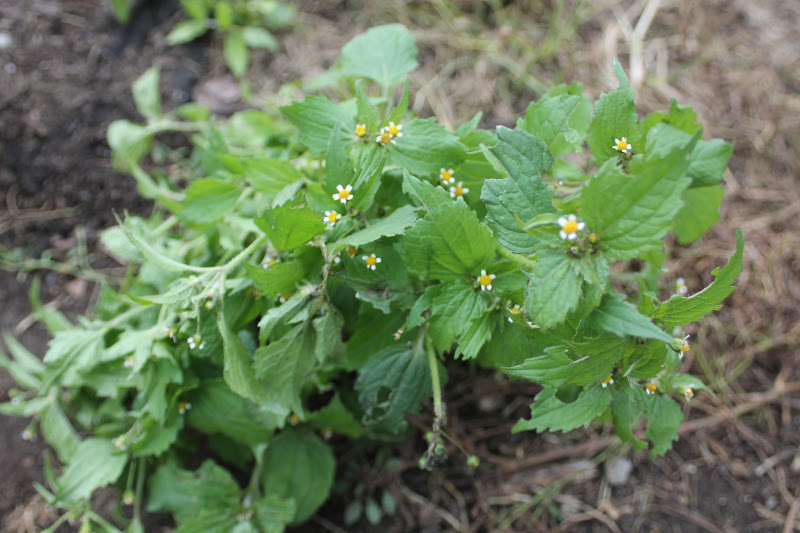
My youngest sons and I also took a tour around a nearby community garden at the suggestion of a friend. We found numerous edible plants there (and I don't mean the ones growing in people's gardens), but a couple of new ones that I'll mention in particular. There was a whole field full of quickweed, which I had only seen in pictures until then. My book says quickweed is bland and best mixed with stronger-tasting greens, so it might not be something to get too excited about, but it certainly could be collected in quantity from this location! Apparently one should collect young plants in the summer. I don't think I could recognize the plant without its flowers at this point, though, and right now all the plants have flowers, anyway (and young plants don't have flowers).
 |
| Purslane laid on our picnic blanket. |
We also found plentiful supplies of purslane, which I did find at our train station last year but have not come across since. Apparently, purslane is the bane of gardens everywhere except the one at my house. Supposedly, if you chop off a bit of root and leave it lying on the ground, it will re-root itself. It is thus frustratingly difficult to get rid of. It retains large amounts of water, so it is also highly drought resistant. Nonetheless, when I tried to encourage some in my own garden by planting a bit from the train station last year, it never took off. It's too bad because purslane is extremely rich in nutrients and also quite tasty (it has a lemony zing to it and is pleasantly juicy).
Photo Gallery
 |
| When hazelnuts are ripe, the husks usually turn brown. |
 |
| These hazelnut husks are still partially green, but the nuts are ripe. If a bush has any ripe nuts, all the nuts should be ripe. |
 |
| Unfortunately, although I was checking on them frequently, I missed the elderberries this year. This picture shows the bare stems where the berries used to be. I posted pictures of nearly ripe berries previously. The elderberries grow in the same place as the hazelnuts. I still haven't tasted them -- maybe next year. |
 |
| My oldest and youngest sons picking hazelnuts. |
 |
| Unlike hazelnuts, black walnuts should be picked from the ground. |
 |
| Our bucket of black walnuts. |
 |
| Sheep eat wild plants all the time! Here my boys are feeding a hungry lamb some unidentified weeds at Old Sturbridge Village. The lamb appeared to be ravenous, if the way he gobbled up their offerings was any indication. |

| Another shot of the boys feeding the sheep. |
|
|
 |
| My oldest son and the sheep. |
 |
| My two oldest boys admire the numerous ground-cherry plants at Old Sturbridge Village. |
 |
| Close-up of the ground cherries. The fruits are enclosed in the little green lanterns (which turn straw-colored when the berries are ripe; see my previous post). |
 |
| My two oldest boys (middle on the left, oldest on the right) pose as 1800s New Englanders. This picture absolutely cracks me up. |
 |
| An evening primrose rosette. This is the stage (i.e., without a flower stalk) at which the plant should be when you collect the root. Plants with flower stalks have used up most of the energy in the root, and it will be fibrous and difficult to chew. Evening primrose starts as a basal rosette (like the one here) the first year. Its second year, it sends up a flower stalk. |
 |
| My collection of evening-primrose roots, with greens still attached, and my digging tool (an "asparagus knife") beside them. |
 |
| My middle son with an evening-primrose root. |
 |
| This whole field is filled with quickweed. |
 |
| Purslane, the bane of every garden but mine. Gardeners should get smart and eat it!. Or they can give it to me! |